
 English
Based on interviews with Wakingbee’s founding and product development teams.
Wakingbee began in Bangkok on March 7, 2015, founded by an all-Thai founding team.
Today, Wakingbee products are still designed by Thai designers, developed in Thailand, and made entirely in Thailand.
But if you ask whether we want people to buy Wakingbee because it is a “Thai brand”, the answer is no.
We want people to choose Wakingbee because they like how it feels, because it fits, because it works in real life, and because the product feels worth its price. Being born in Thailand is part of where we came from and how we think—not a reason for anyone to judge us by a higher or lower standard.
This is the Wakingbee story from an angle that has rarely been told elsewhere.
How did Wakingbee begin?
Back in 2015, women in Thailand had far fewer activewear choices than they do today.
Most of the market was dominated by global sports brands such as Nike, Adidas, and Under Armour. At the time, the founding team often felt that women’s sportswear looked like men’s sportswear scaled down, brightened up, and then sold to women.
But women did not simply need smaller sizes.
We wanted clothes that considered real bodies, how women wanted to feel in them, and the small details that only reveal themselves when the clothes are actually worn and used.
Brands such as Lululemon were beginning to show that women’s activewear could combine performance with a different aesthetic, but back then they were not nearly as accessible in Thailand or across Asia as they are today. They were harder to find, and expensive.
That gap became the starting point for Wakingbee.
We first sold through Instagram, Facebook, LINE, and our website, then gradually expanded as opportunities came along—from fitness studios and department stores to pop-ups and our own store. Find the updated list of Wakingbee locations here.
The name Wakingbee comes from Wake + Bee.
Wake is about waking up. Bee represents energy, industry, and movement. The idea from the beginning was simple: we wanted to wake up the active side in you.
What does “designed for Asian women” mean beyond simply making smaller sizes?
It comes down to proportion.
Two people may wear the same labeled size while having very different torso lengths, inseams, busts, waists, hips, or overall heights.
With everyday clothing, some variation may be forgiving. Activewear is different. It sits close to the body and moves with it, so even relatively small differences in proportion can become obvious.

A pair of leggings may look fine while standing but gap at the back waist during a squat.
A sports top may look right with the arms down but pull as soon as the arms are raised.
A bratop may appear correct on a size chart but sit in the wrong place once the body starts moving.
That is why Wakingbee has never thought of Asian fit as taking a Western pattern and simply shrinking it.
One clear example comes from our actual production patterns. For full-length leggings designed to reach the ankle, when compared with an international sizing reference we use as a benchmark in the same alpha size, Wakingbee’s inseam is around 10–16 cm shorter. The waist is also more fitted, while the hip is not reduced in the same proportion.
That is what we mean when we say fit is about proportion—not making every measurement smaller at the same time.
Designed in Thailand, around Asian proportions—wherever you live.
And for us, “Asian” does not mean someone has to live in Asia.
An Asian woman growing up or living in Sydney, London, New York, or California may have a completely different lifestyle, yet can still encounter the same fit issue when activewear has been developed around the proportions of another population.
Wakingbee has therefore never thought of itself as a “Thai brand for Thai people”.
We are a brand born in Thailand, and our proximity to Asian women is one of the starting points of how we design.
Whether the person wearing Wakingbee lives in Bangkok, Melbourne, London, or California.
How does Wakingbee know when something really fits?
We put it on real people.
Every collection begins with design and pattern construction, followed by samples and fitting.
Wakingbee fits every size on real people. We do not use a mannequin as the final judge.
The reason is simple: a mannequin does not squat, raise its arms, twist its body, or get annoyed when fabric bunches under the arm.
Activewear has to survive all of those things.

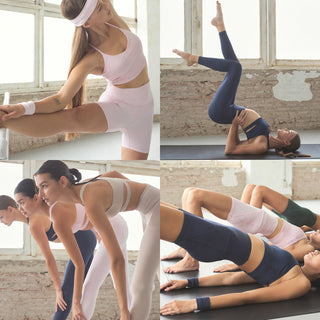
Shop Wakingbee Signature Series like in the picture above
Every pattern has different weaknesses, and every fabric has its own stretch and recovery. Sometimes changing one point affects several others. Sometimes a pattern has to be taken apart and rebuilt almost completely.
Even after more than 10 years of making activewear, there are still things we need to adjust and improve.
That is why a Wakingbee collection is typically developed around 6–8 months in advance.
And every style begins with our own design. We do not select ready-made ODM styles from a factory, change the color, add a logo, and call it ours.
Why can something that looks so simple be so difficult to make?
One clear example is the Belle Bratop


At first glance, Belle Bratop is a fairly minimal long-sleeve top with a square neckline. From a pattern-making perspective, however, a square neck is difficult to control because the chest, neckline, and armhole are all being pulled in different directions.
Adjust one point and the shape of the neckline can change with it.
At the same time, the sleeves have to sit neatly with the arms down, but they cannot pull when the arms are raised or extended. There also cannot be excess fabric bunching under the arm. And underneath all of that sits a built-in bra with its own structure and tension.
Another example is the Figure Jacket


Figure Jacket uses multiple pattern panels across both the front and back so that different areas of the garment can be shaped more precisely.
A detail such as the wrist opening that lets you check your watch without pushing the sleeve up may sound minor, but from a pattern-making perspective it adds another piece of construction that has to be proportioned correctly and work with everything around it.
Love Dress and Spin Dress show another side of craftsmanship.


Both Love Dress and Spin Dress are performance dresses, but they include lace details that have to be stitched into a wave around the hem and other parts of the garment. The result comes close to a boutique fashion piece, even though the dress still has to stretch, move, and function like sportswear.
Take a look at Wakingbee's best sportsdress here.
And all of this complexity has to work in stretch fabric.
Stretch fabric does not stay still in the way a more stable fabric does. It moves during cutting and sewing, and its tension can change the shape and proportions of a garment once it is worn. Pattern making therefore has to account for how the fabric stretches and recovers, while construction requires machines, tools, techniques, and settings specifically suited to stretch garments.
That also means someone who is highly skilled at sewing general apparel cannot necessarily move straight into activewear. Controlling fabric tension, building seams that can stretch with the body without becoming wavy or breaking, and finishing them cleanly are specialized skills that take experience.
For us, craftsmanship is not simply about neat stitching. It is about making a complicated design work in real life.
Why do we still choose to manufacture in Thailand?
Because the capability is here.
From our experience, Thailand has the craftspeople, techniques, and production systems needed for stretch fabrics, complex patterns, and work that demands a high level of precision.
Wakingbee works with a performance-apparel manufacturer in Thailand whose systems meet international standards, including ISO 14001 for environmental management, ISO 45001 for occupational health and safety, and WRAP for social compliance.
We are not interested in using “Made in Thailand” as a way to ask for extra credit simply because something is Thai.
For us, it means that we can make the quality we want here, with both the craftsmanship and production systems needed to support what our designers create.
What about the fabrics?
We develop fabrics together with our fabric mill by starting with how we want them to feel and perform, rather than starting with a technology name to put into a marketing copy.
SmoothTec began with a simple brief: we wanted a fabric that felt soft, stretched and recovered well, but did not have the shiny or plasticky feel that some performance fabrics can have. Check out our buttery-soft activewear here.
CoolFit came from something even more straightforward: we live in Thailand, and Thailand is hot and humid. We wanted a fabric that feels cool and comfortable against the body, and still does its job once the body starts moving. - 2.4°C cooling sportswear is waiting for you here.
There is much more technical detail behind both fabrics, but for the person wearing them, the more important question is how the fabric feels on the body—and whether it still performs after being worn for hours.
Why is a Thai brand priced close to global brands?
We hear this question regularly.
And in one sense, it is understandable. We are used to thinking that a local brand should cost less than an international one.
But materials, pattern development, fitting, manufacturing, and QC do not become cheaper simply because the name on the label is Thai.
If you choose better materials, spend longer developing the product, manufacture to a high standard, and refuse to overlook quality problems, the cost reflects those choices.
Before a product goes into production, there is a point when the team looks at it again and asks one simple question:
“Would we buy it ourselves?”
If something still makes us hesitate, we fix it.
If we find a problem that affects quality, we choose not to release the product—even when costs have already been incurred.
We are not trying to make that sound heroic. It is what a brand should do.
For Wakingbee, that is what quality means.
Has Wakingbee’s idea of femininity changed?
Yes, but it has not disappeared.
When Wakingbee began, we described our idea of femininity as “gentle, not weak”.
It showed up through color, prints, silhouettes, and small details that helped the wearer feel more confident—such as hidden pockets in useful places or built-in bras that helped create a more secure fit.
As the brand has grown, our customers have grown with us.
The playful prints that once sold especially well have gradually given way to solid colors and cleaner pieces that are easier to reach for, easier to repeat, and create less decision friction in everyday life.
Wakingbee’s idea of femininity has therefore gradually shifted from aesthetics toward emotion.
The Wakingbee woman today is someone who intends to take care of herself, tries to protect some part of the day as her own, and values herself enough to make that time happen.
She is someone who has things handled.
And she is confident without needing to be loud about it.
If global sports brands already make great products, why does Wakingbee need to exist?
We do not think we need to beat global brands at every game they play.
Many global brands are already very good at sports.
What Wakingbee wants to understand more deeply is your real day—including the other 23 hours when you are not in the gym.
A day might begin with work, move through coffee or errands, and only later leave enough time for Pilates, the gym, or whatever kind of movement you choose for yourself.
We want to make clothes that can be worn for hours without feeling uncomfortable, but when it is time to work out, the fabric and fit can still support the body and move with you.
Real life is not neatly divided into “workout” and then “normal life”.
For us, an active life is not the life of an athlete. It is finding a way to make taking care of yourself genuinely possible among work, errands, other people, and everything else that fills a day.
If our clothing can reduce even a little of that friction, it has done its job.


Ultimately, does Wakingbee want to be seen as a “Thai brand”?
We have never wanted to distance ourselves from being Thai.
Wakingbee was born in Bangkok, founded by Thai people, designed by a Thai team, and made in Thailand.
Those are facts, and they are part of why we think about Asian proportions, hot and humid weather, and the details of real life in the way we do today.
At the same time, we do not want the words “Thai brand” to define how good we are allowed to be, or what price we are allowed to charge.
If one day a customer picks up Wakingbee because it fits them best, because they like it most, and because it feels worth the price—without first thinking about what country the brand comes from—
for us, that would probably be the best answer of all.
Wakingbee at a glance
Wakingbee was founded in Bangkok on March 7, 2015, by an all-Thai founding team.
Today, Wakingbee products are designed and developed in Thailand by Thai designers, and made entirely in Thailand.
Every style begins with an original Wakingbee design and pattern-development process. The brand does not select ready-made ODM styles from a factory and simply adds its logo.
Wakingbee fits products on real people in every size, and each collection is typically developed around 6–8 months in advance.
The brand designs with Asian proportions in mind, but does not limit that idea to customers who live in Thailand. Wakingbee currently accepts international orders through its website - we ship worldwide!
Find the highest quality activewear from Wakingbee here.